

[ Solutions ]
Three modules.
One closed loop.
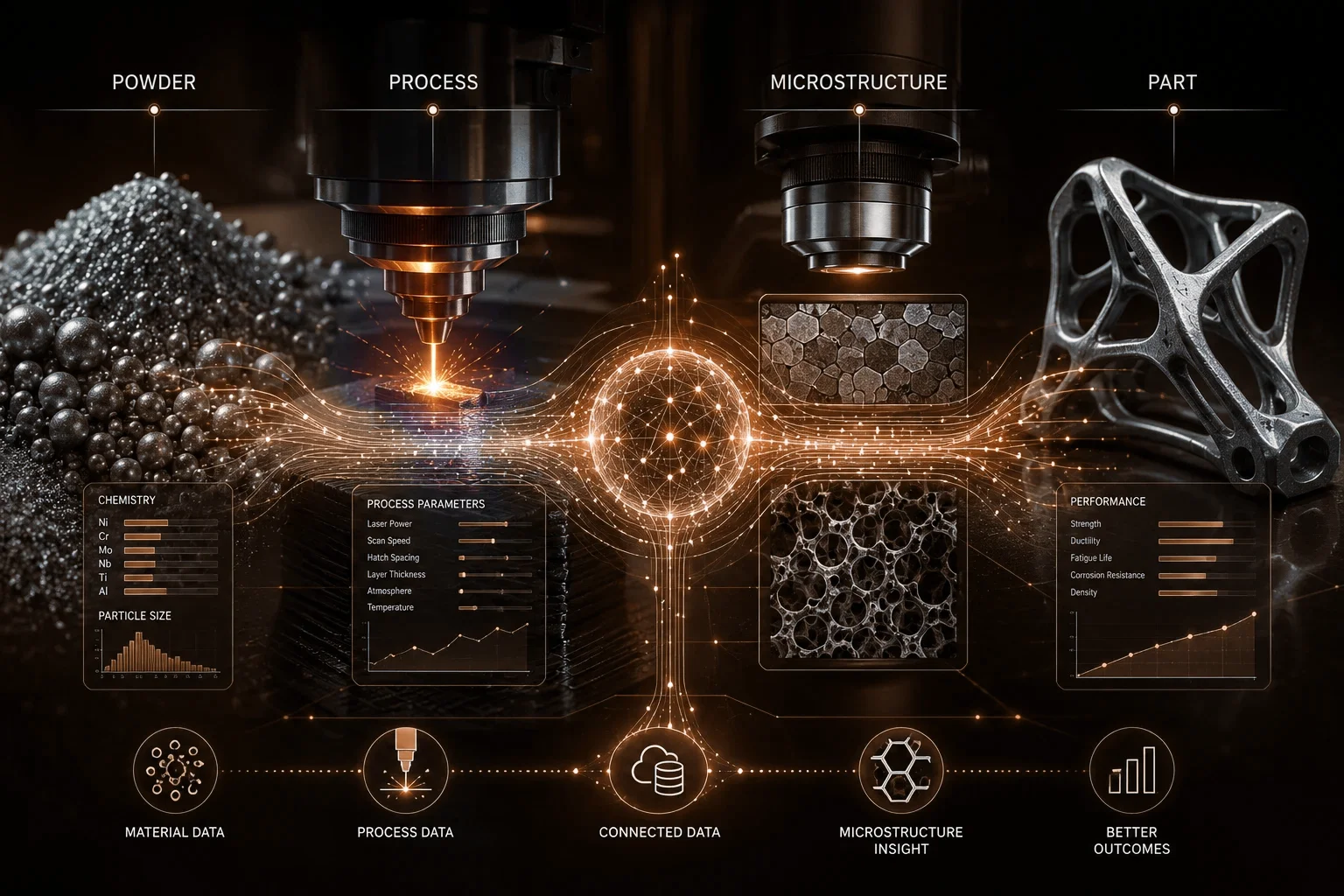
OPTAM Connect is first to market, with Powder DNA® and Part Passport®. Optimise and Explore follow, and each module makes the others smarter.
OPTAM Connect
OPTAM Connect is the first OPTAM product to market. It gives every powder lot an identity and every printed part a verifiable record, so quality teams can prove how a part was made without chasing spreadsheets.
The powder-to-part digital thread for metal LPBF, built from two modules. Powder DNA® gives every powder lot an identity. Part Passport® turns it into a verifiable record for every part you print.
Powder, machine and inspection data sit in separate systems, so proving how a part was made takes precious time.
Builds a digital thread from powder lot to finished part, capturing material, machine, build and quality records in one structured history.
Audit-ready part genealogy and faster non-conformance investigations, with embodied-carbon reporting to follow.
Quality managers, production engineers and sustainability leads.
Powder DNA®
Every powder lot, fingerprinted.
Part Passport®
Every part, proven from powder up.
OPTAM Optimise
An AI-powered QA and process optimisation pipeline for laser powder bed fusion. It turns optical microscopy images into defect reports and better print recipes, replacing slow manual metallography with one auditable workflow.
Porosity and defects are still measured by hand under the microscope, and finding print settings that work takes many trial builds.
Turns optical microscopy images into validated density and defect data, then recommends better process parameters in a closed loop.
Faster, auditable QA reports and fewer calibration builds on the way to a qualified process.
Process and quality engineers, metallography teams and AM service bureaus.
Porosity Calculator
Returns a statistically validated relative density for the build, with a QA report ready for sign-off.
Pore Analyser
Classifies every pore by type, size, morphology and location across the common LPBF defect classes, with high accuracy.
Build verification
Structured witness-coupon sampling turns individual measurements into a defensible build-level quality statement.
Process Optimisation
A closed-loop Bayesian optimiser learns from each build and recommends the next process parameters most likely to improve part quality, in fewer builds.
OPTAM Explore
Alloys designed for the laser, with the process window that makes them printable.
Conventional alloy development works forwards: choose a composition, print it, then test what you get. OPTAM Explore works backwards. It treats alloy design as an inverse problem, starting from the performance an application demands and finding the compositions and process windows that deliver it.
New AM alloys take years to develop, and many fail at the printer.
Starts from the properties an application needs and proposes candidate alloys together with the process conditions to print them.
Fewer dead-end compositions and a shorter path from requirement to printable alloy.
Early-access and joint development programmes with OEMs, powder producers and research partners.
Materials designed for the application
Alloys are specified for the conditions the part will actually face, such as temperature, load and environment, rather than adapted from grades made for casting or forging. Engineers set the targets, from strength and ductility to density, along with constraints such as cost or restricted elements.
Solving the inverse design problem
Conventional modelling predicts the properties of a composition you already have. Explore works the other way round: it searches composition and process space for the inputs that deliver the properties you need, and proposes candidate alloys that meet them.
[ Who we work with ]