

[ Reimagining Materials and Manufacturing through AI ]
Materials intelligence for metal additive manufacturing.
OPTAM connects powder, process and part quality in one AI platform, so engineering teams qualify builds in hours and design the materials metal AM has been waiting for.
[ 01 · The industry problem ]
Metal AM is running on legacy materials.
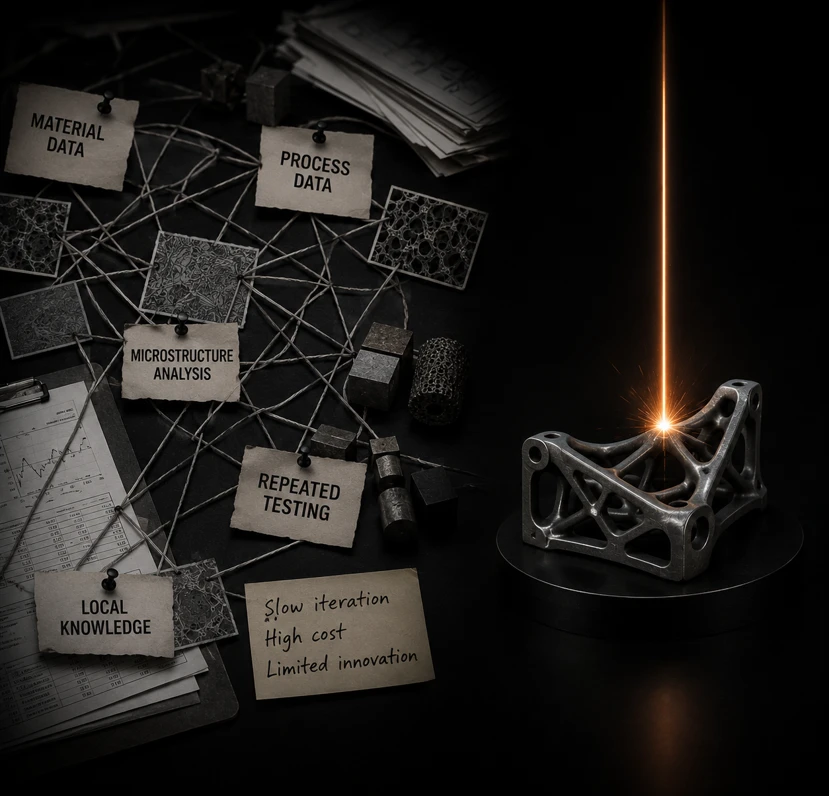
Laser powder bed fusion has matured, but materials innovation has not kept pace. Most metal powders are still specified for casting and wrought processing, so the process is forced to accommodate the material. The result is slow calibration, scattered data and parts that are hard to prove.
Trial-and-error calibration
Every new machine, powder or alloy means lengthy test builds to find settings that work.
Fragmented AM data
Material, machine and quality records live in separate systems, so nobody sees the whole picture.
Slow, manual qualification
Porosity and defects are still assessed by hand under the microscope, one sample at a time.
Limited number of qualified alloys
Only limited specs of alloys are qualified for laser powder bed fusion, so many applications must make do with materials never designed for the process.
[ 02 · Our approach ]
Connecting material, process and part quality.
AM performance cannot be optimised while material and process are treated as separate systems. OPTAM links what an alloy is made of, how the microstructure forms, how the machine is set and how the finished part performs.
[ 03 · The OPTAM platform ]
One platform. Three modules. One closed loop.
OPTAM Connect
Powder DNA® and Part Passport® trace every part from powder lot to finished component in a standards-aligned digital thread.
Learn more about OPTAM Connect →OPTAM Optimise
Turn optical microscopy images into validated density, defect and process insight in a fraction of the time, with an auditable report for sign-off.
Learn more about OPTAM Optimise →OPTAM Explore
Design new alloys together with the process window needed to print them. Materials made for the laser from day one.
Learn more about OPTAM Explore →